Showing posts with label literary fiction. Show all posts

2012/05/07

The Sense of an Ending by Julian Barnes

The Sense of an Ending
Julian Barnes, 2011, 150p.
I have returned to full-time work after some time off, and my brain is a bit saggy when it comes to reading. I was reading a longer book, and the edition I had was a mass market paperback from the 1970s. The typesetting was tight and the font was flabby, and the story itself (which I will finish, I swear, etc.) centres around an incestuously connected rural community. The claustrophobia was overwhelming. I picked up The Sense of an Ending, and it was just the perfect solace.

Closer to a novella than a novel, and set openly in a calming, slender Bembo1, I felt comfortable here. Beyond the material aspects of the book, the story itself has a polar opposition to the tight knit rural aspect of the other2: The main characters have lives that touch and diverge, lives that interact in profound ways, but do not press up against each other.

Tony Webster is a middle-age man, retired from a career of little consequence. He has a wife and a daughter in his past, both also marginally in the present. An unexpected and inexplicable inheritance sets off a chain of memory and re-figuring his history.

The first section of the novel is his recollection of his friendship with Adrian Finn, an anomaly who joined his school clique. Adrian is extremely smart and much more self-possessed than the rest of the group. Webster's memory is unreliable and reconfigured, the ordering and timing of events from forty years previous is naturally gone. He remembers as we remember: incidents, particularly ones we revisit (and perhaps reauthor). Any sense of narrative can only be retrospective. The feelings of such replayed memories play rebalancing games, I think.

There are the original perceptions from the time remembered, but with a younger mind, perceived with a blunt tool. Reversing the perceptions back into a reality with an adult mind (more mellowed and circumspect) produces distortions.

"...as the witnesses to your life diminish, there is less corroboration, and therefore less certainty, as to what you are or have been."

What happens then when we stumble upon artifacts and consequences from these times? When looking at an old photo, or reading an old letter, some shard of the reality is available for present day interrogation. The context is lost and distorted, and reconciling is jarring. Surely we can know something about our own past, but how much seems impossible to say.

When Webster receives an unexpected letter from a solicitor, he begins a process of discovery. What had he really done? What were the consequences? How much could he ever learn about his own past? This is the sort of discovery we might all make, and that occasionally we crave. What became of an old friend? What were the consequences of the way I ended things with her?

The world Tony seems to have created (but only now partially enters) is frankly a bit fantastic. His old girlfriend Veronica is extreme, Adrian Finn's actions were doubly or triply extreme, and so on. Barnes is mysterious with the plot: Webster clearly only deserves to know part of the story, and the author doesn't want to make the "truth" any more accessible to the reader. I wish Barnes had left the gaps in the motivations and sequences of the actions, rather than making the actions themselves so fantastical. Certainly it makes the truth inaccessible, but in a much less satisfying way. One of the many ideas here is that we don't live in our own wakes, consequences radiate off us and our awareness and understanding of them is necessarily incomplete. But here Tony simply appears to connect and incite unbalanced people.

This novella won the 2011 Man Booker, and I find it hard to be too critical. Indeed it is fluidly and engagingly written. There are ideas here that grab the reader and distract from the paucity of depth and breadth; the ideas presented are baldly and sometime repetitively accessible. Nothing makes the reader work hard, but the mysteries of character create an illusion of narrative depth. This mystery also seems to imply complexity in the secondary characters without having to invest much time on them. Tony is a bit of a vacuum of a character, but fortunately the story and ideas require that. When I was finished, I wasn't sure whether this was excellence of craft or some form of cheating, or perhaps something more like a shortcut executed by an craftsman. Does he take us where we want to go efficiently, or are we only going on a trip of a couple of blocks?

Thin, elegant, spare, immediate, unflabby and accessible. I was sucked in by the Bembo, and the text delivered on its promise. A promise of a literary experience in 10 easy steps, with a cola's balance of cold refreshment and warm nutty depth of flavour. This work captivated me and provided precisely what I was looking for, and I was burping away on the ideas joyfully for quite a while. Is it a great book? It shouldn't be required to be great, but perhaps winning Man Booker sets the expectations a tad too high.

Notes:
  1. I am not an intense type geek, but I often will look for a note on the title verso about the typesetting. Bembo is one I always enjoy seeing.
  2. The other book is John Nichols' The Milagro Beanfield War.

2012/03/06

American Pastoral by Philip Roth

American Pastoral
Philip Roth, 1997, 423p.
Roth's1 longtime alter ego, writer Nathan Zuckerman, has become fascinated with Seymour "Swede" Levov. Levov was a childhood acquaintance, an older boy who was a local hero. In Jewish pre-war Newark, Levov appeared to transcend their race and accomplish an American heroism that eluded the rest of the community. Nicknamed "Swede" for his anomalous blond hair and blue eyes, Levov is a football, basketball and baseball star athlete, and son of a Newark glove magnate.

The novel starts with Zuckerman's first person narrative of his encounters with the "Swede", and the broad details of Levov's adult life are revealed. The direct encounters with Levov in the framing narrative reveal what appears to be bland American perfection. A high school sports hero, Levov joins the war effort and is elevated to hero without being deployed. He marries Miss New Jersey, 1949 (Irish-Catholic Dawn Dwyer) and inherits his father's glove empire after genuine effort. He moves out of the city to a century stone farmhouse in an upper-middle-class WASP rural bedroom community. In the 1980s, Zuckerman encounters Levov briefly, and learns that he has remarried and has young sons. Then in the 1990s, Levov mysteriously reaches out to Zuckerman, seeming to want to relate a story. They meet at a restaurant, but Levov talks mostly about his sons and about the turmoil of the 1967 Newark Riots2. Zuckerman doesn't probe, and concludes that Levov has had the sort of life one might predict. His excellence and profound American alignment have provided a frictionless life, not without effort, but without tumult.

The framing narrative ends at Zuckerman's 45th high school reunion. Levov's younger brother Jerry, a childhood friend of Zuckerman, reveals the story that carries the second narrative. In 1968, Levov's daughter Merry appears to have planted a bomb in her hometown which kills a man, presumably to protest the war in Vietnam. She is only 16 at the time, and she goes underground, never to reemerge. Zuckerman reels. Here is, he assumes, the story Levov wanted to relate, but could not. The frictionless life was upended; truly, it disintegrates in the late 1960s and early 1970s.

With the "facts" laid before the reader, along with some statement of Zuckerman's fascination, we descend into a yet deeper fiction — Zuckerman's imagining of a specific period of Levov's life. With themes and ideas explicit and the blurring of "fact" and fiction made plain in the frame narrative, Zuckerman disappears from view, never to return. This story is laid out in the third person subjective, deeply from Levov's perspective, but with Zuckerman's intents. This narrative runs roughly from the Newark Riots in 1967 to 1972 and the Watergate Hearings, with glances backwards to Merry's childhood and Levov's courtship of Dawn. As readers, we know this story is Zuckerman's attempt to rend sense from what he has assembled of Levov's life, but this indirection doesn't deflate the immediacy of the portrait.

While specific to his circumstance, and punctuated by astonishing extreme, this is a surprisingly broad portrait of American undoing.

In the midst of riot, social upheaval, integration and disintegration, is Seymour Levov's personal bomb: Something insensibly abrupt, permanently unaccountable. Roth is ruthless with Levov, and with the reader, and I admit that I spent perhaps too much of my reading awed by his daring. He builds his story around an unbelievable act, and offers us both believability and scope, but never sedates us with accountability. Causality and reason are toyed with: were they too liberal as parents? was Merry brainwashed? her debilitating stutter? or more subtle psychic poisoning of the violence and disorder of the time? Zuckerman/Roth are building a fictional reality here, and cannot allow explication here. To successfully account for Merry's choices would be farce, but Levov is human and must try.

Roth is generous, he permits Levov a partial reconstruction: another marriage, other children — though we only know of Levov's late life from the framing narrative. The story ends with a sort of washing away of the surfaces of lives, a lengthy Thanksgiving scene where many lives are revealed as veneer over disorder. It is an ending that opens out, life continues for all, with a chance for renewal but never for genuine escape.

Roth challenges, and indeed I found this a challenging book. At times slow and contemplative, but punctuated with real and imagined violence and disorder. He leaves you clamouring for a handle on both the landscape and the circumstance. There is so much here, so much detail, so much history, so many complicated relationships, so much ambivalence and tenderness, bound together with a hopeful confusion, and an almost unbearable reality seems to emerge from the confusion. Unbearable, perhaps, but generous and rewarding.

When Roth/Zuckerman's gaze settles on the descent of Levov and Merry's father/daughter relationship, I started to wonder if the novel was a poor choice for a generally anxious father of a very young daughter. Later, I wondered if maybe it should be required reading for anxious new fathers of girls. In the end, it is a nonsense question — this sort of reading can challenge and open you, or beat you down into a dark and angry space, or perhaps a dozen other outcomes all hinged on the reader. Such a work is a latent energy, and reviewing it is like reviewing kerosene. There is power here, but figure out quickly how to handle it, or set it aside.

Notes:

  1. I last (and first) reviewed Roth in Everyman, a much shorter, and less punishing work.
  2. Newark plays a fairly major role in the novel, and the sensible/senseless Newark riots are a sometimes explicit counterpoint to the sensible/senseless of Merry.

2012/02/25

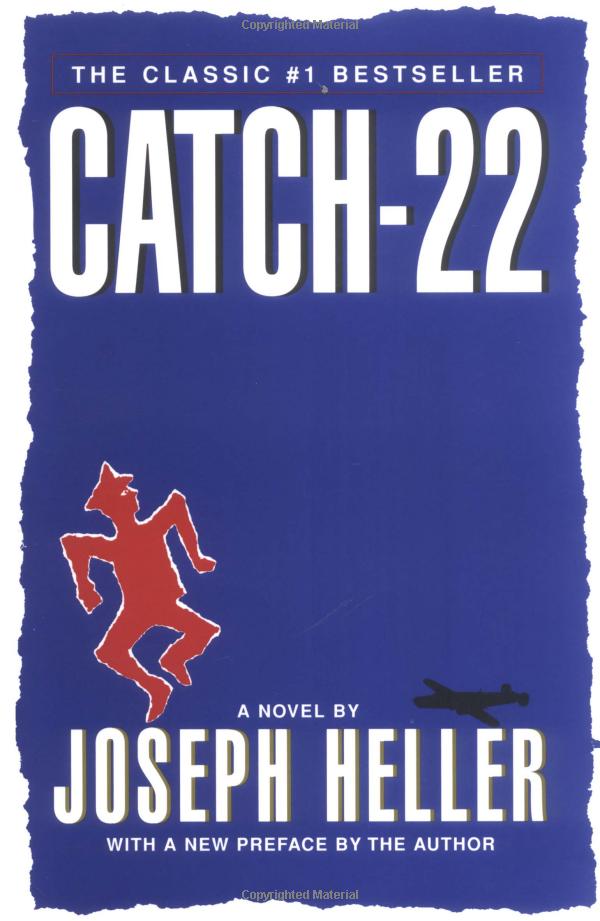
Catch-22 by Joseph Heller

Catch-22
Joseph Heller, 1961, 453p.
A famous book always seems to drag along more baggage than it should. When I know of a book but haven't read it, I tend to delude myself into thinking that I know the book. For example, I've never read Dune, but I have an odd confidence that I know what it is, and what it is all about. I have a sense based on all sorts of cluttered nonsense that has cobbled itself together into an illusion of an understanding, and the moment I start reading it there will be a sudden falling away. The brain is a wicked beast this way, assembling assumptions, and I forgive it these miserable trespasses because it always proves itself fully plastic in that moment of vacuum. The moment of vacuum when you set eyes on the actual words, and your brain detonates the clutter and there is an eerie stillness of nothing. Why does this often seem a more rewarding experience that a true blank slate? Or is that just me?

I picked up Heller's (only1) classic novel with some odd sense that it would be like Joseph Conrad; that it would be a dark and strongly narrative; that it would be a personal story through war and self; that it would be sequential, uniform and fairly serious. Why did I think any of that? I can't say, the sources for all these misapprehensions were presumably razed along with everything else in the reading of the first chapter.

What I should have imagined it to be was something like Kurt Vonnegut, because it is something like Kurt Vonnegut. It isn't entirely, but if you are sitting down to not read this book tonight, that is a much better wrong place from which to not begin.

Catch-22 is not serious, it is absurd. It is not narrative, it is episodic. It isn't sequential, it is looped and deconstructed in time. It is not uniform, it is fragmented and shifts tone. It isn't personal, it is almost maniacally impersonal. Or at least, all of this becomes very clear in the first half of the novel. By the end, things are much harder to pin down so neatly.

The protagonist (of sorts) is Captain Yossarian, a American bombardier in the Second World War, stationed in a fictional air force base on a non-fictional but fictionalized island off the coast of Italy. Yossarian threads through everything, but particularly in the first third of the novel we can lose sight of him for as much as a chapter as characters, situations and settings are carefully and comically presented. We flit from one character to another with only loose connections joining one chapter to the next, and in each chapter are a handful of half-resolved threads that are drawn up again later. Laid thickly on top of all these vignettes is a double helping of uproarious absurdity that had me laughing aloud regularly. Dark absurdities are picked up and played with for a bit, then set down again: the absurdity of military structure, of medicine, of faith, of death, of trade and commerce, and particularly the absurdity of the war.

The tone is comic, but the motions of a comic novel are restricted in this setting — it becomes clear that we investigate many of these absurdities, but have to move along when the absurdity meets the horror. We learn, for example, that during a bombing mission gone horribly wrong, an officer named Snowden is killed. Yossarian is never the same after, and the change in him is a catalyst for the absurdity of his awakened responses to his surroundings. He is in a situation where he is nearly certain to eventually die in any number of horrible ways, but in an environment where self-preservation is absurd, and the structures that work to suppress self-preservation are equally absurd. Again and again, the narration picks up Snowden's death, but is forced to put it down again before fully investigating it.

The absurdity here is the kernel of the novel, and what Catch-22 really is. The idea that reality and reality exist mostly at cross purposes with each other, that survival means non-survival and non-survival means survival. If you want to fight, you are crazy and shouldn't; if you want to run you are sane and you should be made to fight. It also means that power is predicated on order but can only create disorder. That rules exist to be enforced but not read, that belief is tolerable only in a vacuum of understanding.

But in painting this characterization of the great disorder, Heller is meticulous but not self-conscious in his structure. While he apparently meanders randomly through his landscape, something odd happens. The absurdity remains, but I stopped laughing. With the people and concepts laid out carefully with us in a comic and open mood, he rotates everything 90 degrees and he has us trapped. Yossarian cannot escape this dark comedy alive, Dunbar simply ceases to exist, Orr evaporates into the sea, others fall into despair, others into madness2. In the first half I found myself irritated as Heller introduced character after character after character, the last half I realized he had to — this is a war and they will all be consumed before the end. When they are finally revealed to us after much preparation, the demises of Snowden, McWatt and so many others aren't any less absurd. But this absurdity is tragic as well as comic.

When Catch-22 was first published, some of the major reviewers felt it lacked craft. It has an ambling sense to it that feels disordered until it comes together and you comprehend the structure. And here, perhaps, is where the baggage does the novel a great favour: I read this knowing it was a classic, and I was patient with the quirkiness of the form. Though my strange expectations fell away quickly, my great expectations didn't, and I read a great book where I might have just tolerated an amusing book.

Notes:

  1. From Heller's New York Times obituary: "When an interviewer told Mr. Heller that he had never written anything as good as Catch-22, the author shot back, 'Who has?'"
  2. Despite all of this, I should note that the book ends on an attempt at hope. It didn't entirely work for me, but the skill of the construction redeems it entirely. Though I would like to say more, I've already spoilered.

2012/01/07

Everyman by Philip Roth

Everyman
Philip Roth, 2006, 192p.
I've wanted to read something by Philip Roth since the excellent Writers & Company interview with Roth in the spring1. It isn't particularly surprising that I never have; I have read astonishingly little. I have had a bit more time and inclination to read over the last few months, and it is hard not to be overwhelmed with great choices. It is easy to feel like you don't even know enough to start making choices. The desire to seek shelter in lists is enormous — "10 Great Novels of the 20th Century"-this and "The Western Canon"-that2. Roth shows up in most of these lists as a key voice, and an astonishingly consistent one. He has won awards, written bestsellers, and regularly makes critic's and reader's lists for this and that, and he has for 50 years. My library provides NoveList to subscribers, which provides "start with" guidance to readers for a given author, and this was the selection for Roth3. As usual, inspiration combined with science and the library to place this novel at the top of my list.

The novel opens with the funeral of the protagonist, in a run down Jewish cemetery with deep family connection. His daughter and brother speak at length, his second ex-wife reflects on the impossibility of the situation, his bitter sons throw dirt on the coffin. His brother casts light on their childhood as sons of a jeweller in Elizabeth, New Jersey in the 1930s and 1940s, and on the bones of his life. While the skeleton materializes quickly (three wives, three children, one sibling, advertising creative who retired to paint) the mysteries materialize too. Why are his sons cold and bitter? What happened to these marriages? Why did he grow cold to his brother in his final year? What isn't mysterious is that the protagonist had medical problems for years.

With the external view of him in retrospect settled, the body of the novel addresses his life from within, and is structured primarily by his medical history. The book moves through his childhood hernia operation (his first night sleeping in a strange place away from family) to his final heart problems with seven operations in seven years, the last fatal. While we learn the story of the life and the struggles of his body, many of the mysteries from the funeral are revealed. How two of his marriages ended, and how two of them started. We learn about his relationships with his children, we learn about his final years. While we skip back and forth, the medical history mostly progresses serially. So many at the end of their lives tell their stories as a sequence of surgeries and illness, here is a whole life told this way.

Most readers will not find him wholly sympathetic, particularly his choices and impulses that lead to of the end of his second marriage. Nor will many enjoy his bleak but lucid outlook on his situation. But he is largely honest and aware of his mistakes and embarrassed by his troubling desires. He might unconvincingly justify his actions at times, but with a hint of resignation rather than anger. Genuine anger seems to bloom in him only with regards to his sons, who find any forgiveness impossible, and harbour sneering rage for decades. And perhaps there is some unfocused anger about his health, which bleeds into his relationship with his brother.

The title "Everyman" comes from the name of the unnamed protagonist's father's jewellery store; he picked the name to suggest that the jewellery was accessible to all, but also to avoid the challenges of a Jewish name. Roth invites the reader to determine in what way our nameless protagonist is "everyman"4, but it is clear that he isn't a typical "everyman" character. The structure of his childhood and adult life are not universal, and the reader isn't particularly welcome to identify with him. He is an everyman only in that he lived, he ages and he dies, and there is some universality in all of these.

If this sounds bleak, in places it is. But in my reading, at least, it was bleak with a profound tenderness. There are a series of vignettes around death and aging that I think dance between something universal and something genuinely embodied. The protagonist teaches a painting class for a time in his retirement community, and he has an encounter there with a woman coping with persistent, horrible back pain, but without her husband who was (or she feels was) the key to her vigour. Her predicament is both immediate and unreachable, and Roth's tenderness towards her is cutting but never pitying, and always matter of fact.

Roth's work here is tremendously skilled, circling around ideas, peeking at them from a couple of angles before the reader finds themselves submerged in them. The method allows him to work mostly in an accessible and undramatic way. The patterns and approaches become clear after you are finished; the reader's repeated visits to the same rundown ceremony build things up carefully, then leave the reader alone with the results. This sort of careful, human work tends to shatter me in the most rewarding way, and I have to admit I felt overwhelmed when I finished.

In reading this novel (and currently reading his American Pastoral) I am developing sympathy with Roth's desire that literature be left to the readers and the reading. Trying to discuss or review or explain this sort of work feels like a disservice or worse. I should just say I revelled in the skill, was engaged by the narrative and moved by whatever there is here that goes beyond the narrative.

Notes:

  1. Elinor Wachtel's interview with Roth is worthwhile. They discuss Everyman, but because he gives interviews so rarely, she discussed his whole career with her usual depth. I've occasionally joked that I could never be an author because I don't remember my childhood well enough to answer Wachtel's questions.
  2. Particularly overwhelming is Harold Bloom's list from The Western Canon with about a hundred key books before you reach Dante.
  3. The NoveList recommendation here seems very sound; this work is short, accessible and full of what I understand are key themes and settings for Roth. I think that the "start with" advice is somewhat uneven; I am not sure I would start Pynchon with Gravity's Rainbow, as it suggests.
  4. The NPR Fresh Air interview with Roth about Everyman explains his reasoning for leaving the character nameless. I love listening to Roth, but I don't think that this is a particularly good interview. My alternate theory about the lack of a name is that it is due to Roth's clear antipathy towards critics and writers about literature — they, like me above, are force to write "the protagonist" and "the unnamed narrator" and other similarly clumsy chore phrases.

2011/11/28

The Music of Chance by Paul Auster

The Music of Chance
Paul Auster, 1990, 224p.1
David Mitchell's Ghostwritten, which I recently reviewed2, referenced The Music of Chance repeatedly in the segment set in London. The protagonist of that section was in a band called "The Music of Chance", after "a novel by that New York bloke". This century being what it is, I Googled the novel, and within minutes it was on hold for me at the library down the street. Years of serious Wikipedia addition compel me to at least try to follow these links, but link networks get fatter as you traverse them, and time and attention become rarefied and dusty. However, following this link led me towards a rewarding reading experience of four Auster works in fairly short order3.

The novel starts with Jim Nashe driving. Driving and driving. His wife has recently run off, and he has sent his young daughter to be raised by his sister. His estranged father has died, and left him with a modest fortune. After visiting his daughter, he finds himself compelled to drive. He leaves his job as a fireman, and simply starts driving. He drives for over a year, stopping along the way, periodically visiting his daughter and a woman he becomes attached to. The compulsion to drive eventually consumes his inheritance and he finds himself detached from everything but his daughter and sister. With his finances coming to an end, but his restless lust for driving unsatisfied, he happens upon Jack Pozzi, a young man who has obviously just been severely beaten.

Pozzi is a semi-professional gambler with a "sure thing" lined up, but no financing. Nashe goes all in with his remaining cash, in the desperate hope of feeding his need to drive. The story comes to a climax during the "sure thing", a poker game with two lottery millionaires, but the climax is soon deflated as the story takes a sharp turn. Pozzi and Nashe lose more than everything to the millionaires, and become indentured servants, building the millionaires' folly — a wailing wall in a meadow made from imported stones from a long destroyed Irish castle.

While Pozzi balks at the indignity, Nashe struggles with the task but sees it almost as an opportunity. With few connections in his life, and no vision for the future, the isolation and purpose of the folly appear to shift his inertia. But their situation is ambiguous and paranoia reasonably blooms. Are they employees, or slaves? Where they cheated? Will they ever be able to leave?

In each section of the story, Auster allows tension to build, but then whips us down different paths before allowing the tension to resolve, and at a certain point in the story, I found myself getting physically anxious. Repeatedly the author appears to be accelerating towards a climax, but leaves the reader hanging. In the end there is no resolution but rather an eruption.

Late in the story, Nashe is alone in the small trailer set up beside the folly, and he is given a small electric keyboard. He has some of his old sheet music salvaged from the trunk of his car, and starts playing. He discovers that pieces written for the harpsichord sound best on the keyboard, as it has poor volume control. He focuses in on a famous piece by French composer Couperin called "Les Barricades Mystérieuses". He seems to recall that no one was certain what barricades the title refers to. To him there is something compelling about the way the piece builds momentum then slackens but refuses to resolve its internal tensions. Like Mitchell in Cloud Atlas, Auster uses an embedded musical work to wink at rather than explicate the structure of the work, though in Auster's case it is a reference rather than a product of the fiction itself.

I wasn't familiar with Couperin, only enough to know that he was non-fictional. Upon hitting the reference and understanding the importance to the work, I put down the novel and pulled up the Wikipedia page for Couperin, and was listening to a YouTube recording of "Les Barricades Mystérieuses" on a harpsichord within a minute or so4. This sort of referential gratification made me reflective: it would have been entirely impossible when this book was written just over 20 years ago. I could have perhaps found a book or a recording within a couple of days at the library, but only perhaps. Google, Wikipedia and YouTube would seem to render all text into hypertext — while I couldn't click the reference in this hardcover, I was nevertheless satisfied nearly as quickly with text, images and audio.

Does this immediate satisfaction deflate some of the mystery of the work? Does it make a deeper understanding of the work more accessible to the musically obtuse5? Or does it distract from the primary work by embedding it in nest of links?

To be fair, I was led to this compelling novel by following links, so perhaps it is only appropriate than links should lead me back out again.

If you crave a traditional plot or firm resolutions, then this book isn't a good match; it is a novel but not precisely a story. However, the skillful structure and propulsion of the narrative made this effective and affecting. The author's almost reckless manipulation of tension and his persistently eerie tone made this hard to put down.

Notes:

  1. Full disclosure: My library copy had the first edition cover, not pictured. The first edition cover is possibly the ugliest book cover I have ever seen, and I can't bring myself to post it or even link to it here.
  2. My recent review of Ghostwritten by David Mitchell.
  3. I followed up this novel by reading Auster's New York Trilogy, which in an ideal world I would review soon.
  4. A version for harpsichord and discussion of the name "Les Barricades Mystérieuses".
  5. My neighbour owns a harpsichord, and was intimately familiar with the piece; he would have resolved the reference without digital means. The connecting power doesn't give me something universally impossible, but rather makes something universally possible.

2011/11/23

Ghostwritten by David Mitchell

Ghostwritten
David Mitchell, 1999, 436p.
David Mitchell's debut novel, composed of nine loosely interconnected stories that stretch across Asia and then towards the west. I read Mitchell's Cloud Atlas earlier this year, which featured a set of six interconnected stories. Where Cloud Atlas's stories were nested, and moved forward and then backwards in time, the stories in Ghostwritten take place in roughly the same time and universe. As in the later work, these stories are connected not just by character and coincidence, but also by themes and ideas. Ghosts appear in all the stories, but in various forms - from literal haunting ghosts to ghostwriters to sleeper agents to... well, no spoilers.

It is hard to talk about this novel without using the phrase "astounding debut." This is a first work by a writer who was just 30 at the time this was published, but his confidence and ambition is stunning. He begins moving through Japan to Hong Kong and then into mainland China, establishing a startling sense of place and building (mostly) compelling primary characters for each segment in relatively short stories (each of the first seven stories are around 30 pages). Ignoring the quality of the writing for a moment, you have to pause and admire the gumption of a debut novelist who starts off with a brainwashed cult terrorist on the run in coastal Japan, seething with disgust for the local masses of unconverted. Anger, fear and rank delusion right from page one, and then we are off across the landscape of the world.

With each section, there is a shift in perspective and sometimes in style and tone, though much less so than in Cloud Atlas, where each section is written in a different dialect and genre. The bulk of the stories could work as interesting standalone short stories, though some of the later stories build a little on earlier stories. The second story was a particular favourite of mine: a stalled young Japanese man in Tokyo has ensconced himself in a record store, surrounded by the jazz he loves, but conscious that this isn't where his life is likely to lead. A very sweet and simple love story sets him back off on a journey again, but I was invested both in the journey and in his contemplative stasis. The fourth story ambitiously attempts a history of modern China from the perspective of a woman running a lone tea shack on the side of Holy Mountain1, from her despoiling as a girl by a warlord's son in the late feudal era, through the cultural revolution to the modern day.

After five excellent and distinct segments, it was almost a relief to find that Mitchell hadn't sold his soul for unearthly powers. The sixth segment is an underwhelming art caper in Saint Petersburg, Russia which I dragged myself through with some effort. This section lacked the sense of place that many of the others had, and the primary characters largely bored me. The seventh segment moves to London, and while it isn't the strongest in the novel, I perked right back up. Perhaps Mitchell intentionally let his tightness slip here, before the novel starts accelerating towards its gasping conclusion? He has the skill and the balls to manipulate the reader this way, but I somewhat doubt it. I could imagine him jerking the reader around a bit with a referential but implausible story2, but I can't imagine him intentionally letting the mood and landscape belly flop.

The connections between stories read more like Easter Eggs than critical to the story; companies and people and stories that pop up and satisfy our need for connection, but don't necessarily inform the plot. And there is something of a major plot arc here, I think, though it is somewhat hard to elaborate. Since the traditional novel forms are eschewed, the reader needs to work harder to grasp at the whole. Because the plot (if there is one) is tangled with the reoccurring themes and ideas, the reader is pushed into thinking more about ideas than activities. Or rather, that was my approach - I think that the structure encourages a deeper reading, but doesn't insist on it. You could stroll through this as a collection of crisp short stories or as character studies.

Overall, I didn't like this as much as I liked Cloud Atlas, but it did feel less ostentatious. In between these two books, he wrote number9dream with some similar choices and themes, which certainly gains a spot on my "to be read" list.

Notes:

  1. Apparently Mount Emei, the highest of the Four Sacred Mountains of Buddhism in China.
  2. I raise this mostly because he does do something like this in Cloud Atlas, and it worked for me. However, in that case each nested story casts its outer story as potentially fiction and definitely as text or other media, and some of the inner stories critique the outer ones. There isn't that sort of internal interaction with text here, though. Without one section explicitly commenting on another section, which doesn't happen here, I am not sure it makes sense.